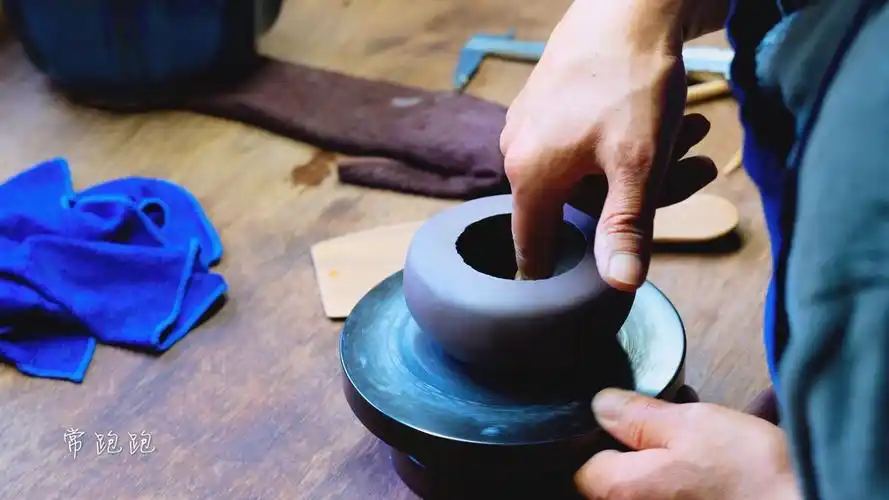
The raw materials used for Yixing purple clay pottery include three types: purple clay, green clay and red clay, collectively referred to as purple clay. Purple clay forms an interlayer in the kaolin ore bed, with ore bodies in thin and lenticular shapes; the ore layer is generally tens of centimeters to about one meter thick and has poor stability. The raw material is purple or purplish-red in appearance with pale green specks, and turns purple, purple-brown or purple-black after firing.
Purple clay is mainly composed of hydromica, with varying amounts of kaolin, quartz, mica scraps and iron oxides. Comprehensive analysis shows that purple clay belongs to the granular soil-quartz-mica series and bears great resemblance to porcelain-making raw materials. Therefore, a single type of this raw material possesses ideal plasticity, with clay blanks featuring high strength and low drying shrinkage, providing excellent technological conditions for a wide variety of shaping designs.
Green clay is the intercalated fat in purple clay, hence its nickname “clay within clay” (Tuanshan clay, by contrast, is a mixture of purple clay and green clay formed by paragenesis). Green clay has a low yield and a tender texture, and its fire resistance is also lower than that of purple clay. It is generally used as a facing powder or coating on the surface of clay blanks, adding more rich colors to Yixing purple clay pottery wares.

Red clay (also known as Zhuni clay) is a type of clay found at the bottom of tender clay ore beds, with fragmented ore deposits that require manual sorting and selection. Zhou Gaoqi once noted: “Yellow stone clay, mined from Zhaozhuang Mountain, is the unweathered stone core of the ore; when fired into pottery, it turns into a cinnabar red hue.” Due to its varying iron content, it transforms into shades of cinnabar red, cinnabar purple or crabapple red after firing.
Owing to its low yield, in the early days, Zhuni clay was only used to make the bodies of small flat teapots exported to Southeast Asia; for the most part, it was merely applied as a slip coating on purple clay blanks for decorative purposes. As for the refined clay used for Zhuni teapots, it is produced by master potters who process raw red clay through washing and sedimentation to obtain a fine-grade clay with a particle size of approximately 140 to 180 mesh. This meticulous process results in exquisitely smooth Zhuni teapots with a texture akin to fine grease.
The most distinctive feature of Zhuni clay’s mineral composition is its extremely high iron oxide content, ranging from about 14% to 18%—this is the primary reason why Zhuni teapots take on their characteristic red hue after firing. Zhuni clay is extremely delicate in its workability, making it highly challenging to shape into pottery. Furthermore, it has an extremely high shrinkage rate of 30% to 40% from the green body stage to firing, which means the yield rate of qualified finished products is only around 70% on average.