Add
Room 7-101, Fangjing Zisha Cultural Tourism City, West Changan Road, Dingshu Town, Yixing City, Jiangsu Province
service@teateatok.com
Room 7-101, Fangjing Zisha Cultural Tourism City, West Changan Road, Dingshu Town, Yixing City, Jiangsu Province
service@teateatok.com
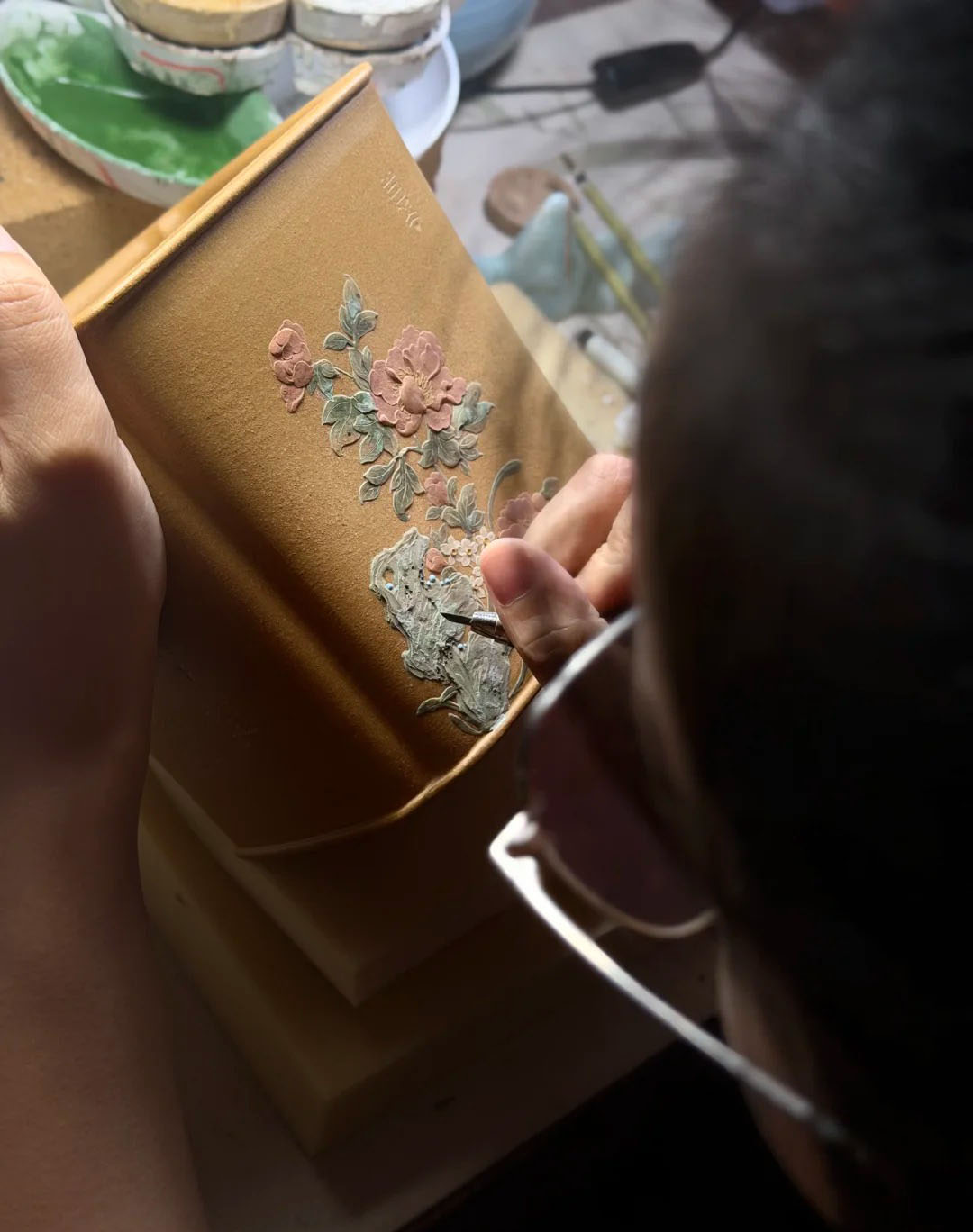
Slip-painting, also referred to as Ni Hui, is a distinguished traditional decorative art exclusive to Yixing Zisha pottery. Regarded as “decorating clay with clay”, this craft uses natural Zisha clay slip as paint instead of chemical pigments or glazes. After kiln firing, the decorative pattern merges into the clay body, creating a lasting artwork that will never fade, peel or flake off.
The whole slip-painting procedure requires rich experience in clay properties, shrinkage rates and firing behaviour. Even minor mistakes in humidity, slip thickness or drying speed can lead to cracks or separation between the painted layer and the pot body.
Artisans first select raw Zisha ore of different natural tones. The ore is crushed, weathered, refined and sieved into fine powder. The powder is mixed with purified water and stirred repeatedly to create smooth clay slip. The viscosity of the slip must be precisely adjusted. Thicker slip is used for piled painting to build up relief texture, while thinner slip works for delicate flat painting. No artificial colourants are added; all colours come purely from natural iron and mineral content inside the Zisha clay.
Slip painting can only be applied on unfired, leather-hard Zisha clay bodies. The moisture level of the blank is critical. If the body is too dry, it will quickly absorb water from the slip and cause cracking. If the body is too wet, the painted pattern will blur and deform. The artisan checks the surface carefully, trimming away blemishes and smoothing the surface before decoration.
With a fine brush, the artisan lightly sketches the composition on the clay surface. Common themes include landscapes, plum blossoms, lotus, chrysanthemums, peonies, animals and Chinese poetry.
For flat slip painting, the artisan applies thin layers of clay slip to render fine details. For piled slip painting, multiple layers of thicker slip are stacked gradually to create a shallow relief effect. Every stroke must consider the shrinkage difference between the slip and the base clay body after firing.
Once painting is finished, the piece is placed in a cool, shaded and well-ventilated area for slow drying. Rapid drying under direct sunlight or heat will make the slip layer shrink faster than the base body, resulting in cracks and peeling. This stage may take days, depending on the thickness of the piled decoration and ambient humidity.
After full drying, the artisan carefully trims the edges of the slip decoration. Excess clay is shaved and polished to smooth rough ridges. The artisan reviews the whole pattern, touching up tiny flaws and adjusting the balance of the composition. This step refines the relief texture and ensures the decoration blends naturally with the vessel shape.
The decorated Zisha ware is loaded into the kiln for high-temperature firing. During firing, both the base clay body and the slip decoration sinter together. The clay slip fuses tightly with the host body, becoming an integrated part of the teaware. After cooling, the slip-painted pattern is permanently embedded in the clay.
Once fully cooled, the finished piece is inspected. Artisans check for cracks, distortion, colour uniformity and sharpness of the painted motif. Only pieces that meet strict quality standards can be sold as finished slip-painted Zisha teaware.
Slip painting demands dual expertise: the artisan must master traditional Chinese painting, while deeply understanding Zisha clay behaviour. It remains one of the most admired decorative techniques for collectible Yixing teapots, gaiwans and teacups.