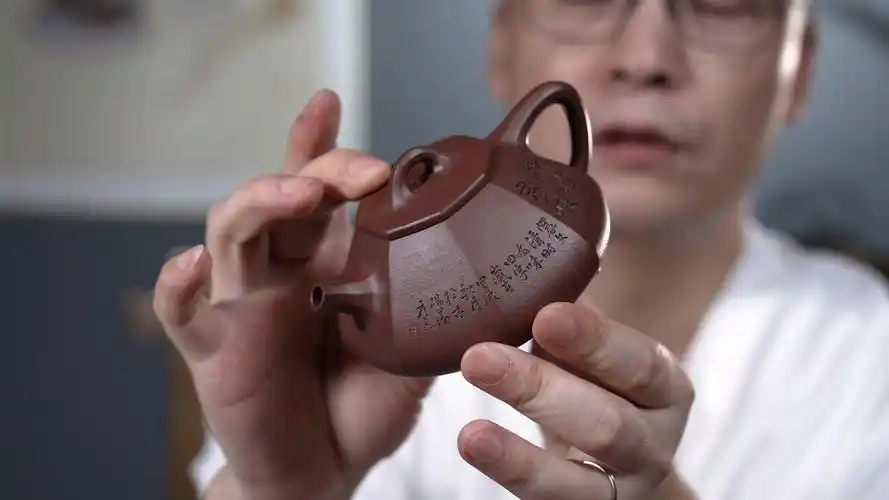
- Purple clay pottery is refined from sandy clay: it neither impairs the tea’s aroma nor imparts a starchy taste to the brewed tea, thus preserving the full color, aroma and taste of the tea when used for brewing.
- Sandy clay teapots can absorb tea infusion: with prolonged use, a layer of tea sediment patina accumulates inside the pot, so even pouring boiling water into an empty pot will release a faint tea fragrance.
- The unique material of purple clay teapots grants them excellent air permeability, which keeps the tea’s original flavor and ensures the brewed tea stays unspoiled overnight even in hot summer.
- Easy to clean: if left unused for a long time and develops an odd smell, simply scald the pot with boiling water two or three times, pour off the cold water, and it will brew tea with the original flavor intact.
- High adaptability to sudden temperature changes: in the bitter cold of winter, pouring boiling water into the pot will not cause it to crack due to abrupt thermal shock. Moreover, the sandy clay conducts heat slowly, making the pot cool to the touch no matter how you hold or lift it.
- Purple clay pottery is resistant to firing: it can be placed on a slow fire to brew tea in winter without easily cracking. It is no coincidence that Su Dongpo, the great literatus of the Song Dynasty, once composed the line “Breezes hum like pines by the bamboo stove, we call to each other with teapots in hand” when brewing tea with a purple clay louvered teapot. This is why tea connoisseurs at all times and across the globe have a particular fondness for purple clay teapots.
- Yixing purple clay teapots boast excellent plasticity.
- Yixing purple clay teapots have a low drying shrinkage rate.
- Purple clay can be fired into pottery independently without blending with other raw materials; the finished Yixing purple clay teapots feature a dual-pore structure in the clay body.
- Yixing purple clay teapots require no glazing after forming. Generally, neither the inside nor the outside of purple clay wares is glazed, as their beauty lies in the pure natural texture and grain of the clay. Purple clay tea pots come in a great variety of shapes and styles, ranging from simple and practical designs to exquisite and artistic ones. In general, they fall into the following categories: geometric form, natural form (flower and plain ware), ribbed form, as well as flat teapots and other tea utensils.
Purple clay teapots are beloved by tea lovers not only for their elegant shapes but also for numerous advantages in tea brewing.
- Purple clay is a porous material with a dual-pore structure, featuring tiny, high-density pores. Brewing tea in a purple clay teapot preserves the tea’s original flavor to the fullest.
- Purple clay teapots have excellent air permeability, which prevents the brewed tea from going stale and keeps it unspoiled overnight in hot weather. Even if left unused for a long time, the pot will not develop a stale smell. Simply fill it with boiling water and pour it out immediately, then rinse it with cold water, and the pot will regain its optimal condition, brewing tea with the original flavor still intact.
- Purple clay teapots absorb tea infusion: the inner wall needs no scrubbing, and brewing tea in it leaves absolutely no odd smell. With long-term use, a layer of tea sediment patina accumulates on the inner wall—so much so that pouring boiling water into an empty pot will fill the air with a delicate tea fragrance. This unique quality stems from the certain porosity of the purple clay teapot’s body.
- Purple clay teapots withstand sudden temperature changes exceptionally well: pouring boiling water into the pot in the bitter cold of winter will never cause it to crack due to abrupt thermal shock. Meanwhile, the sandy clay conducts heat slowly, so the pot remains cool to the touch after brewing. Furthermore, it can be placed on a slow fire for heating and boiling without cracking from the flame.
- The longer a purple clay teapot is used, the luster and radiance it gains, with a gentle and elegant charm. Prolonged use and frequent touching and polishing will make the pot’s surface increasingly smooth and glossy. As Wen Long noted in Tea Notes: “I caress and treasure it as dearly as a pearl in my palm. With long use, its exterior glows like purple jade, and its interior shimmers like blue clouds.” Records of Yixing Tea Pots states: “A teapot, with long use and constant cleaning and polishing, emanates a subtle, muted luster that is clear enough to reflect images.”
- Rich and long-lasting tea aroma: Purple clay teapots have a narrow spout and a tight-fitting lid, with a slightly rough inner wall that effectively prevents the tea’s aroma from dissipating too early. A well-used purple clay teapot develops a layer of reddish-brown tea sediment patina on its inner wall; the longer it is used, the thicker the patina becomes, making the brewed tea more mellow and fragrant. Even if no tea leaves are added and only boiling water is poured in, a well-seasoned purple clay teapot will release an inviting tea fragrance—a quality unmatched by ordinary tea utensils.
- Long heat retention: The inner wall of a purple clay teapot contains numerous tiny air bubbles filled with still air, which is a poor conductor of heat. This gives purple clay teapots excellent heat retention performance.
- Cool to the touch when holding: The linear expansion coefficient of purple clay is slightly higher than that of porcelain, and without glazing, there is no issue of body-glaze stress. Fired purple clay teapots contain very little glass phase and possess sufficient ability to withstand abrupt thermal changes caused by temperature differences, resulting in slow heat conduction. They adapt exceptionally well to sudden hot and cold changes—even if steamed and boiled at a temperature of over 100℃ and then quickly placed in ice and snow below zero, the pot will not crack.
- Unglazed inside and out: Retaining tiny pores, purple clay teapots have excellent air permeability while being impermeable to water, and they also have strong adsorptive capacity—an advantage incomparable to ordinary teapots. The pores preserve the delicate fragrance formed by the volatilization of aromatic substances in tea leaves when heated, and increase the late-stage acidity of the tea infusion, which plays a astringent and bactericidal role. This slightly delays the spoilage and souring of the tea, which is the reason behind the saying that “tea stays unspoiled overnight even in the height of summer”.